


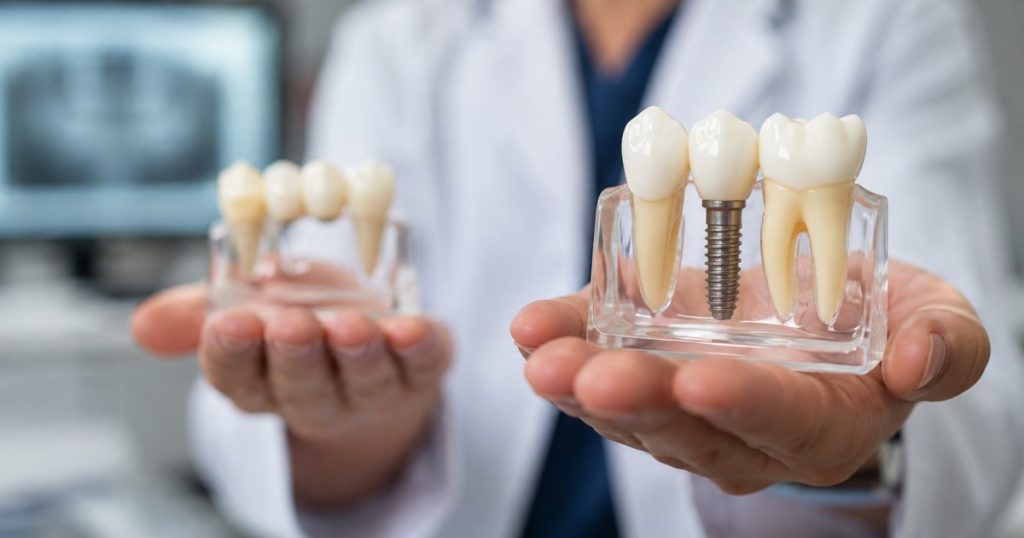
If you’re missing a tooth and trying to decide between a dental implant and a bridge, you’re asking the right question. Choosing the wrong option can affect your neighboring teeth, jawbone, and long-term oral health.
In many cases, a dental implant instead of a bridge is the better choice, especially when your surrounding teeth are healthy, and you want a solution that lasts longer and protects your bone.
Keep reading to see the clear signs that point toward an implant and how to decide what’s right for your situation.
Dental Implant vs Bridge: What’s the Real Difference?
The main difference is simple: A dental implant replaces both the root and the crown of the missing tooth. It is placed directly into the jawbone and stands on its own.
A dental bridge, on the other hand, relies on the neighboring teeth for support. Those teeth are reshaped and crowned so they can hold the false tooth in place.
This single difference (independent support versus relying on adjacent teeth) affects almost every other factor, including bone health, longevity, and how the rest of your teeth are treated.
Related guide: Missing Tooth Replacement Options
7 Signs You Need a Dental Implant Instead of a Bridge
Here are the clearest signs that you need a dental implant instead of a bridge:
1. Your neighboring teeth are healthy
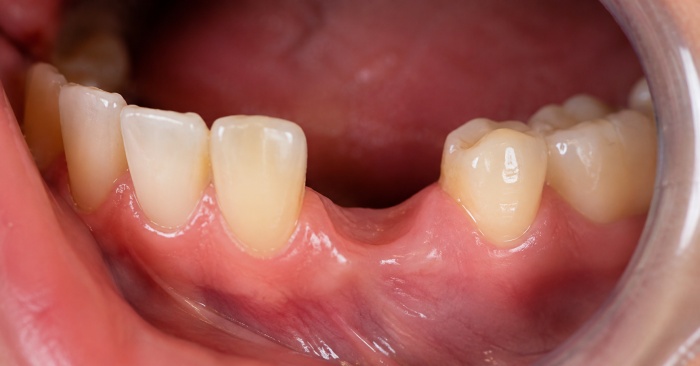
If the teeth next to the gap are strong and free of large fillings or damage, grinding them down for a bridge removes healthy enamel that you can never get back. An implant leaves those teeth completely untouched.
2. You want to protect your jawbone from bone loss
When a tooth is missing, the jawbone in that area begins to shrink because it no longer receives stimulation. A dental implant acts like a natural root and helps preserve bone volume. A bridge does not.
3. You’re looking for a long-term solution
Dental implants are designed to last decades, and in many cases a lifetime with proper care. Bridges typically need replacement every 10 to 15 years.
Research Note: According to studies, the 10-year survival rate of implants supporting single crowns is approximately 95.2%. In comparison, conventional tooth-supported bridges typically show lower long-term survival. Many studies report average lifespans of 10–15 years and 10-year survival rates around 85–90%. (Jung et al., 2012 | ADA summary of survival data)
4. You don’t want healthy teeth ground down
Preparing teeth for a bridge is irreversible. Once enamel is removed, those teeth will always need crowns. An implant avoids this compromise entirely.
5. The missing tooth has been gone for a while
The longer a tooth has been missing, the more bone loss usually occurs. An implant can help stop further deterioration, while a bridge simply sits above the gum and does nothing to support the bone underneath.
Read more: Why Your Gum Health Is More Important Than You Think
6. You’ve had problems with previous bridges
If a past bridge has loosened, failed, or caused decay in the supporting teeth, switching to an implant removes the reliance on neighboring teeth and reduces the chance of repeating the same issues.

7. You prefer natural feel and easier cleaning
An implant functions and is cleaned much like a natural tooth. You can brush and floss normally. Bridges require special floss threaders or interdental brushes to clean underneath the false tooth, which many people find harder to maintain.
Don’t Risk Choosing the Wrong Tooth Replacement
The right option depends on your unique situation. For example, if your neighboring teeth are healthy or you want to protect your jawbone, a dental implant may be a better choice than a bridge. So, let our specialists at Lisgar Park Dental evaluate your teeth, bone health, and treatment goals to help you make the right decision.
Book Your Consultation Today!
When a Bridge Might Still Be the Better Option
A dental bridge can still be the more practical choice in certain situations:
- If the neighboring teeth already need crowns due to large fillings or damage
- If you prefer to avoid surgery
- If there is significant bone loss and you do not want grafting
- If you need a faster solution within a few weeks
In the given situations and preferences, a bridge may be the more suitable option for you.
You may find useful: How to Get Affordable Dental Care When You Have No Dental Insurance
How to Decide Finally: Lisgar Park Dental in Toronto Can Help
The right choice depends on the health of your neighboring teeth, the condition of your jawbone, your timeline, and your long-term goals. A proper assessment with imaging done by a specialist is the only way to know whether a dental implant instead of a bridge is the better option for your specific situation.
At Lisgar Park Dental in Toronto, we evaluate these factors carefully and explain both options clearly so you can make the right decision. If you’re ready to find out which solution fits you best, book a consultation with our specialists today through calling us at (647) 370-0590 or visiting us at 68 Abell St Unit RT3, Toronto, ON M6J 0B1, Canada.
FAQ
Does a dental implant last longer than a bridge?
Yes. Implants often last decades or a lifetime, while bridges typically need replacement every 10 to 15 years.
Can I get an implant if I already have a bridge?
Yes. In many cases a failing bridge can be replaced with an implant, depending on bone health.
Is a dental implant more expensive than a bridge in the long run?
Usually not. Although the upfront cost is higher, implants often cost less over time because they rarely need replacement.
Do I need enough bone for a dental implant?
Adequate bone is required, but bone grafting can often rebuild the area if needed.
Will getting a bridge damage my healthy neighboring teeth?
Yes. A traditional bridge requires grinding down the adjacent healthy teeth, which is irreversible.
Have questions about choosing between a dental implant and a bridge? Leave a comment below, and we’ll do our best to answer it.
